SEO vs AEO vs GEO: Powerful Differences Every Marketer Knows
Digital search has evolved dramatically over the past few years. Ranking on Google alone is no longer enough to build a strong online presence. Today, businesses also want their content to appear in AI-powered search platforms like ChatGPT, Gemini, Perplexity, and Microsoft Copilot. This shift has introduced new optimization strategies beyond traditional SEO.
Understanding SEO vs AEO vs GEO is becoming essential for marketers, business owners, bloggers, and content creators. While Search Engine Optimization (SEO) has been the foundation of digital visibility for years, Answer Engine Optimization (AEO) and Generative Engine Optimization (GEO) are changing how users discover information online.
If you’re wondering which strategy is best or whether you should use all three, this guide will explain everything you need to know. By the end of this article, you’ll understand the key differences, benefits, and how to create a future-ready content strategy.
What is SEO?
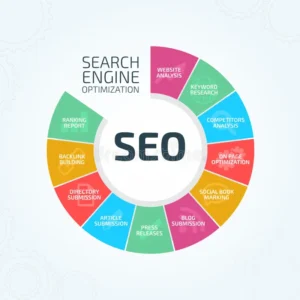
Search Engine Optimization (SEO) is the process of optimizing your website so it ranks higher on search engines like Google and Bing. The main objective of SEO is to increase organic traffic by improving your website’s visibility for relevant keywords.
SEO includes several important practices, such as:
- Keyword research
- On-page optimization
- Technical SEO
- Link building
- Content marketing
- User experience optimization
For example, if someone searches for “best digital marketing agency”, Google displays websites that provide the most relevant and helpful content. SEO helps your website become one of those results.
Benefits of SEO
- Increases organic website traffic
- Builds brand credibility
- Generates long-term results
- Improves website authority
- Offers excellent return on investment
Although SEO remains one of the most effective digital marketing strategies, modern search behavior now extends beyond traditional search engines.
What is AEO?
Answer Engine Optimization (AEO) is the process of optimizing content so that answer engines can easily understand and directly answer users’ questions.
Unlike traditional SEO, where users click through search results, AEO focuses on providing immediate, accurate answers.
Examples of answer engines include:
- ChatGPT
- Google AI Overviews
- Google Featured Snippets
- Microsoft Copilot
- Voice assistants
- Siri
- Alexa
When someone asks,
“What is SEO?”
Answer engines try to provide a direct answer without requiring users to browse multiple websites.
AEO focuses on:
- Question-based content
- FAQs
- Clear definitions
- Structured headings
- Short, accurate answers
- Schema markup
The goal is to become the source that AI systems choose when generating answers.
What is GEO?
Generative Engine Optimization (GEO) is one of the newest digital marketing strategies.
GEO focuses on optimizing content so AI-powered search platforms reference and cite your content when generating responses.
Instead of ranking only in Google, GEO helps businesses become visible inside AI-generated answers.
Popular generative search platforms include:
- ChatGPT
- Google Gemini
- Perplexity AI
- Claude
- Microsoft Copilot
As AI search continues to grow, GEO is becoming increasingly important for businesses that want maximum online visibility.
SEO vs AEO vs GEO: Understanding the Core Difference
Although these strategies are related, they have different goals.
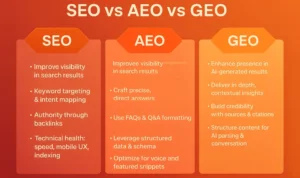
| Feature | SEO | AEO | GEO |
|---|---|---|---|
| Primary Goal | Rank on search engines | Answer user questions | Get cited by AI search engines |
| Focus | Website rankings | Direct answers | AI-generated responses |
| Platform | Google, Bing | Featured snippets, AI Overviews | ChatGPT, Gemini, Perplexity |
| Content Style | Long-form optimized content | Question-answer format | Authoritative, trustworthy content |
| Main Success Metric | Organic traffic | Featured answers | AI mentions and citations |
This comparison shows that SEO vs AEO vs GEO is not about choosing one strategy over another. Instead, they work together to improve digital visibility across multiple search experiences.
Why SEO Alone Is No Longer Enough
For many years, businesses focused entirely on ranking higher in Google search results. While SEO remains essential, user behavior has changed significantly.
Today, people increasingly ask AI assistants questions like:
- What is the best SEO strategy?
- Which digital marketing agency should I choose?
- How does local SEO work?
Instead of visiting multiple websites, users often receive complete answers directly from AI.
Because of this shift, businesses need to optimize content for both search engines and answer engines.
This is why understanding SEO vs AEO vs GEO is becoming more important every year.
How SEO Works
SEO improves rankings through multiple optimization techniques.
Keyword Optimization
Finding the right keywords helps search engines understand your content.
Examples include:
- SEO vs AEO vs GEO
- Technical SEO
- Local SEO
- Content Marketing
Keywords should appear naturally throughout your content without excessive repetition.
High-Quality Content
Google rewards helpful content that genuinely solves users’ problems.
Good content should be:
- Original
- Informative
- Well-structured
- Updated regularly
Long-form articles often perform better because they answer more user questions.
Technical SEO
Technical optimization includes:
- Fast loading speed
- Mobile-friendly design
- XML sitemap
- HTTPS security
- Crawlability
- Proper URL structure
A technically optimized website provides a better user experience and improves rankings.
Backlinks
Backlinks remain one of Google’s strongest ranking signals.
Quality backlinks from authoritative websites help improve trust and domain authority.
However, earning natural backlinks through valuable content is more effective than buying links.
How AEO Works
Unlike traditional SEO, AEO focuses on answering questions clearly and directly.
To optimize for AEO:
Use Question-Based Headings
Instead of generic headings, write:
- What is SEO?
- How does AEO work?
- Why is GEO important?
These headings match real user searches.
Write Concise Answers
Provide the answer immediately after the heading.
Then expand with additional explanation.
This format improves your chances of appearing in:
- Featured snippets
- AI Overviews
- Voice search
- ChatGPT summaries
Add FAQ Sections
FAQ pages help search engines understand your content better.
They also improve visibility for voice search and AI-generated responses.
Use Structured Data
Schema markup helps search engines understand:
- FAQs
- Articles
- Organizations
- Products
- Reviews
Structured data increases the chances of appearing in rich search results.
How GEO Works
Generative Engine Optimization focuses on making your content trustworthy enough for AI systems to reference.
Key GEO practices include:
Build topical authority
Instead of publishing random articles, create multiple related articles around one subject.
Example:
SEO Cluster
- Keyword Research
- Technical SEO
- Local SEO
- On-Page SEO
- Link Building
- SEO vs AEO vs GEO
This helps AI understand your expertise.
Demonstrate Experience
AI systems increasingly prefer content that demonstrates real experience.
Include:
- Practical examples
- Case studies
- Expert opinions
- Original insights
These signals improve credibility.
Maintain Content Freshness
AI platforms prefer updated information.
Review your important articles regularly and update:
- Statistics
- Examples
- SEO practices
- AI trends
Fresh content has a higher chance of being referenced by AI engines.
Why Businesses Need SEO, AEO, and GEO Together
Many marketers ask whether they should focus on SEO, AEO, or GEO. The reality is that these three strategies complement each other rather than compete.
Think of them as different ways to increase your online visibility.
- SEO helps your website rank in traditional search engines like Google.
- AEO helps your content appear as direct answers in featured snippets, AI Overviews, and voice search.
- GEO increases the chances of your content being referenced by AI platforms such as ChatGPT, Gemini, Perplexity, and Microsoft Copilot.
A business that combines all three strategies can reach users regardless of how they search for information.
SEO vs AEO vs GEO: Which One Should You Choose?
The answer depends on your goals.
Choose SEO if you want to:
- Increase organic website traffic
- Rank higher on Google
- Build long-term authority
- Generate consistent leads
Choose AEO if you want to:
- Rank in Featured Snippets
- Appear in Google AI Overviews
- Optimize for voice search
- Answer user questions directly
Choose GEO if you want to:
- Be cited by AI search engines
- Increase brand visibility in AI-generated answers
- Prepare for the future of search
- Build topical authority
The best approach is not choosing one over the others—it is integrating all three into your content strategy.
How to Optimize Content for SEO, AEO, and GEO
1. Write for People First
Search engines and AI platforms prioritize content that genuinely helps users.
Before publishing any article, ask yourself:
- Does this answer the user’s question?
- Is the information accurate?
- Is the content easy to understand?
User-focused content performs better across SEO, AEO, and GEO.
2. Cover Topics in Depth
Instead of writing a short article, create comprehensive guides that answer every important question about a topic.
For example, a complete guide on SEO vs AEO vs GEO should explain:
- What SEO is
- What AEO is
- What GEO is
- The differences
- Benefits
- Optimization tips
- Common mistakes
- Future trends
Comprehensive content is more valuable to both users and AI systems.
3. Use Clear Heading Structure
Organize your content using:
- H1 for the main title
- H2 for primary sections
- H3 for supporting topics
This improves readability and helps search engines understand your content hierarchy.
4. Add FAQs
Frequently Asked Questions are essential for AEO because they answer real user queries in a simple format.
FAQs also increase your chances of appearing in voice search and AI-generated answers.
5. Build Topic Clusters
Rather than publishing unrelated articles, create a connected group of content.
For example:
SEO Cluster
- What Is SEO?
- On-Page SEO Guide
- Technical SEO Guide
- Keyword Research
- Local SEO
- SEO Trends in 2026
- Google Ranking Factors in 2026
- SEO vs AEO vs GEO
Internal linking between these articles strengthens topical authority.
6. Keep Content Updated
Search trends change quickly.
Update your articles every few months by:
- Adding new statistics
- Refreshing examples
- Improving explanations
- Covering new AI features
Fresh content is more likely to rank and be referenced by AI.
Common Mistakes to Avoid
Even experienced marketers make mistakes that affect visibility.
Avoid these common issues:
- ❌ Keyword stuffing
- ❌ Publishing thin content
- ❌ Ignoring user intent
- ❌ Writing only for search engines
- ❌ Using clickbait titles without value
- ❌ Forgetting internal linking
- ❌ Ignoring mobile optimization
- ❌ Not updating old articles
- ❌ Publishing AI-generated content without editing
These mistakes reduce both search rankings and AI visibility.
The Future of Search
Search is changing faster than ever.
Over the next few years, users will increasingly rely on AI assistants to find answers instead of browsing dozens of websites.
This doesn’t mean traditional SEO will disappear. Instead, SEO is evolving alongside AEO and GEO.
Businesses that adapt early will have a significant competitive advantage.
Future-ready marketers should focus on:
- Creating authoritative content
- Demonstrating real expertise
- Optimizing for AI search
- Building trust through consistent publishing
- Providing the best user experience
Frequently Asked Questions (FAQs)
1. What is the difference between SEO, AEO, and GEO?
SEO focuses on improving rankings in traditional search engines. AEO helps content appear as direct answers in AI Overviews and featured snippets, while GEO optimizes content to be cited by AI-powered search engines like ChatGPT and Gemini.
2. Is SEO still important in 2026?
Yes. SEO remains one of the most effective ways to generate long-term organic traffic. However, combining SEO with AEO and GEO provides better visibility across modern search platforms.
3. What is Answer Engine Optimization (AEO)?
Answer Engine Optimization (AEO) is the practice of creating content that directly answers user questions, making it easier for AI assistants and search engines to display your content in featured results.
4. What is Generative Engine Optimization (GEO)?
Generative Engine Optimization (GEO) focuses on improving the chances of your content being referenced and cited by AI-powered search engines and generative AI platforms.
5. Can I use SEO, AEO, and GEO together?
Absolutely. Combining all three strategies helps your content perform well in Google Search, AI search engines, featured snippets, and voice search.
6. How can I optimize my website for GEO?
Create authoritative content, build topical authority, demonstrate expertise, update articles regularly, and structure your content clearly to increase the chances of AI platforms referencing your website.
7. Why is topical authority important?
Topical authority helps search engines and AI platforms recognize your website as a trusted source on a subject, improving rankings and increasing the likelihood of citations.
8. What is the future of SEO?
The future of SEO involves integrating traditional optimization with AEO and GEO strategies, focusing on user intent, high-quality content, and AI-friendly information architecture.
Conclusion
The debate around SEO vs AEO vs GEO is not about choosing one strategy over another. Instead, these three approaches work together to maximize your online visibility.
SEO helps your website rank on traditional search engines, AEO improves your chances of appearing in featured answers and AI Overviews, and GEO prepares your content for the growing world of AI-powered search platforms.
Businesses that combine these strategies can reach more users, build stronger authority, and stay ahead as search technology continues to evolve. Instead of optimizing only for Google, modern marketers should create helpful, trustworthy, and comprehensive content that serves both people and AI systems.
By understanding SEO vs AEO vs GEO, you’re not just improving your rankings today—you’re preparing your website for the future of search.
Looking to grow your business online? Connect with the Best Digital Marketing strategist in Kannur and take your brand to the next level!